


Friendship is precious, but even the closest friends can have misunderstandings. A sincere apology can heal hurt feelings and rebuild trust. These Long Sorry Messages for Your Best Friend will help you express your emotions with honesty and care. Whether the mistake was big or small, the right words can make a real difference.
In this collection, you will find over 270+ Long Sorry Messages for Your Best Friend for different situations. From emotional and heartfelt apologies to thoughtful messages after a fight, there is something for everyone. Choose the message that best matches your feelings and take the first step toward mending your friendship
Heartfelt Long Sorry Messages for Your Best Friend
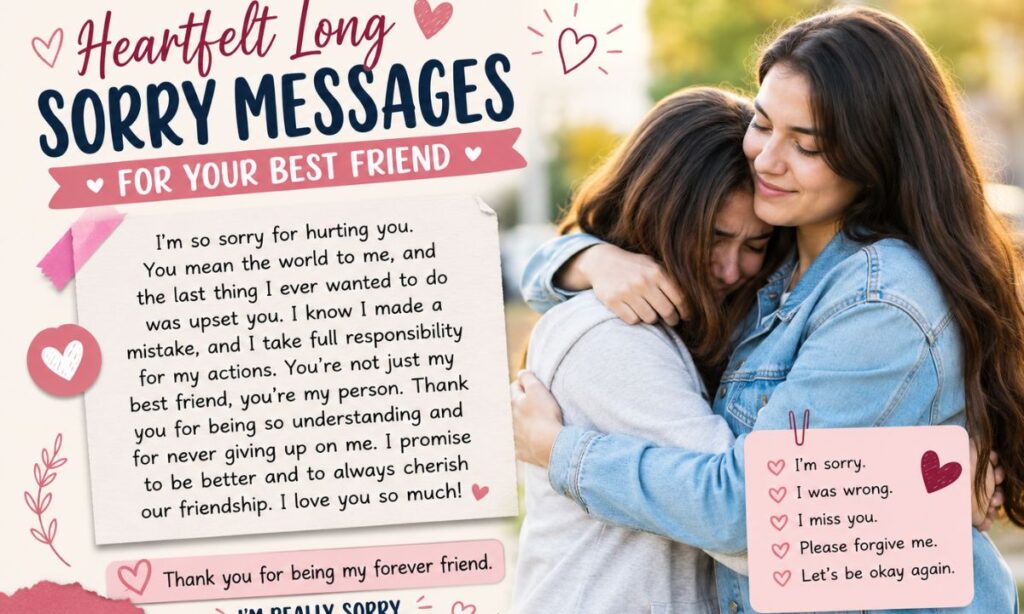
Here are 50 heartfelt one-line sorry messages for your best friend:
- I’m sorry for hurting you — you mean more to me than my pride ever will.
- Our friendship is too precious to lose over my mistake — forgive me?
- I messed up, and I miss you already — I’m truly sorry.
- You’ve always had my back, and I let you down — I’m so sorry.
- No excuses, just an honest apology — I’m sorry, my friend.
- I’d rather say sorry a thousand times than lose you once.
- I’m sorry for the words I said that I truly didn’t mean.
- Forgive me for being careless with something as precious as our bond.
- I hate that I hurt the one person who’s always been there for me.
- I’m sorry — you deserved better from your best friend.
- My heart’s been heavy since our fight — please forgive me.
- I was wrong, and I miss laughing with you like we used to.
- I’m sorry for letting my ego get in the way of our friendship.
- You’ve earned my trust a hundred times over — I’m sorry I broke yours.
- I’d cross oceans to fix this — I’m sorry, truly.
- Our friendship deserves more care than I gave it — forgive me.
- I’m sorry for not listening when you needed me most.
- I know sorry isn’t enough, but it’s where I have to start.
- I miss you more than my stubbornness will ever admit — I’m sorry.
- You’ve forgiven me before, and I hope you can find it in you again.
- I’m sorry for the silence — I should’ve reached out sooner.
- Friends like you don’t come twice — I’m sorry I took that for granted.
- I’m sorry for putting you through this — you didn’t deserve it.
- I let my temper speak louder than my love for you — forgive me.
- I’m sorry, and I promise to be the friend you’ve always been to me.
- I miss our inside jokes — I’m sorry I ruined the mood between us.
- You stood by me through everything, and I failed to do the same — sorry.
- I’m sorry for making you doubt how much I actually care.
- I know I hurt you, and that guilt hasn’t left me since — forgive me.
- I’m sorry for the tears I caused — you deserve only smiles from me.
- Our years of friendship shouldn’t end over my mistake — I’m sorry.
- I’m sorry for choosing pride over you, even for a moment.
- I miss your voice, your advice, your presence — I’m sorry, come back to me.
- I’m sorry I wasn’t the friend you needed that day.
- You’ve seen me at my worst and stayed — please stay now too, I’m sorry.
- I’m sorry for breaking something we built with so much love.
- I regret every word that hurt you — I’m truly sorry.
- I’m sorry for not saying sorry sooner — I was scared, not heartless.
- I miss the way we used to be — I’m sorry for messing that up.
- I’m sorry for hurting the person who’s always healed me.
- You deserve an apology as real as the friendship we share.
- I’m sorry I let my mistake outweigh our memories.
- I know actions matter more than words, so let me prove I’m sorry.
- I’m sorry for making you feel unimportant — you never were.
- Our bond deserves a fresh start — I’m sorry, can we begin again?
- I’m sorry for every moment my mistake overshadowed our friendship.
- I miss you, I regret it, and I’m sorry from the bottom of my heart.
- I’m sorry for not being there when you needed me the most.
- You’ve always forgiven easily — I hope I haven’t tested that too much.
- I’m sorry, my friend — I miss you, and I want us back to how we were.
Understanding the Power of a Heartfelt Apology
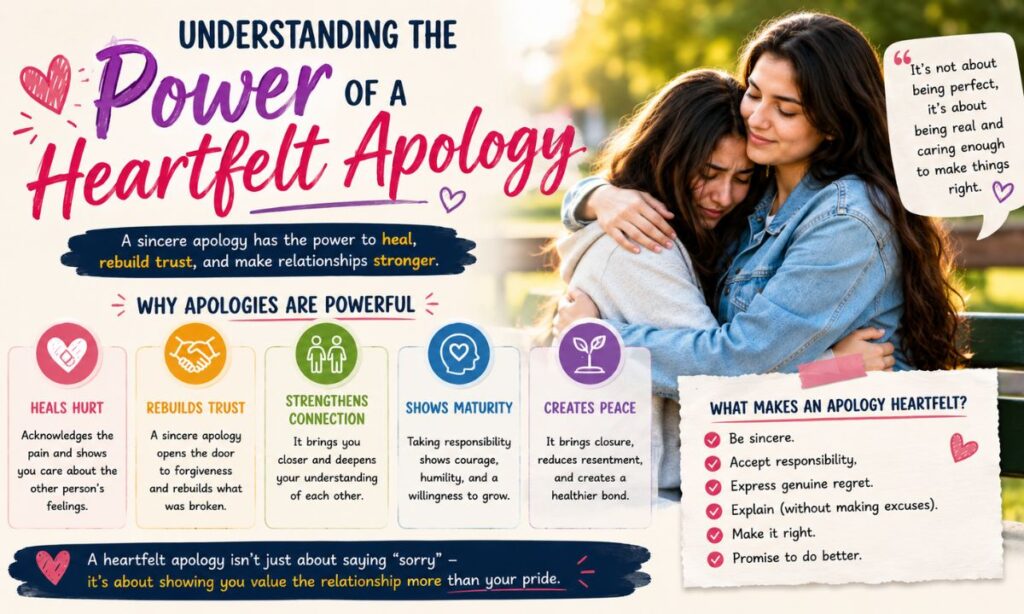
- A sincere apology has the power to heal wounds words alone once caused.
- Saying sorry isn’t weakness — it’s the courage to put someone else’s feelings first.
- A genuine apology can rebuild in seconds what silence destroys in years.
- The right apology doesn’t excuse the mistake — it acknowledges the pain it caused.
- Sorry means nothing without the will to change what caused it.
- A heartfelt apology speaks louder than a hundred unspoken feelings.
- True apologies aren’t about being right — they’re about making things right.
- An apology given with humility can dissolve years of resentment.
- Sorry is a small word that carries the weight of accountability.
- A real apology listens before it speaks.
- The power of “I’m sorry” lies in meaning it, not just saying it.
- Apologies given freely, without conditions, mean the most.
- A true apology doesn’t say “but” — it simply says “I was wrong.”
- Forgiveness begins where a sincere apology ends.
- An apology isn’t complete without the effort to do better.
- Sorry heals faster when it’s paired with understanding.
- A heartfelt apology values the relationship more than the ego.
- The strongest people are the ones who apologize first.
- An apology repairs trust one honest word at a time.
- Saying sorry sincerely can turn distance back into closeness.
- A real apology doesn’t defend — it simply owns the mistake.
- Sorry becomes powerful when it’s followed by change, not just words.
- Apologies given with love mend more than they admit.
- The depth of an apology shows the depth of the relationship.
- A genuine “I’m sorry” can dissolve anger faster than any argument.
- True apologies require vulnerability, not just politeness.
- An apology accepted with grace strengthens a bond forever.
- Sorry, when meant deeply, turns conflict into connection.
- A heartfelt apology proves that love matters more than pride.
- The best apologies come without expecting anything in return.
- Saying sorry sincerely shows emotional strength, not defeat.
- An honest apology repairs more than an argument ever destroys.
- A real apology doesn’t just say sorry — it shows sorry through actions.
- Apologies given with sincerity can turn enemies back into friends.
- Sorry holds power only when it comes from genuine reflection.
- A true apology says, “Your feelings matter more than my comfort.”
- An apology rooted in honesty can rebuild even broken trust.
- Saying sorry with your whole heart can restore what silence broke.
- A meaningful apology doesn’t just ask for forgiveness — it earns it.
- Sorry becomes healing when spoken without pride attached.
- A real apology values peace over being right.
- An apology given sincerely reminds people they are valued.
- True apologies open doors that stubbornness keeps closed.
- Sorry, when heartfelt, can turn a painful memory into a lesson learned.
- A genuine apology repairs relationships that logic alone cannot fix.
- The power of an apology lies in its honesty, not its timing.
- Saying sorry with humility can turn a rival into an ally.
- A heartfelt apology proves maturity more than any argument won.
- True healing starts the moment an apology is offered without excuses.
- Sorry said with sincerity can make even the deepest wounds start to heal.
How Apologizing Strengthens Friendship
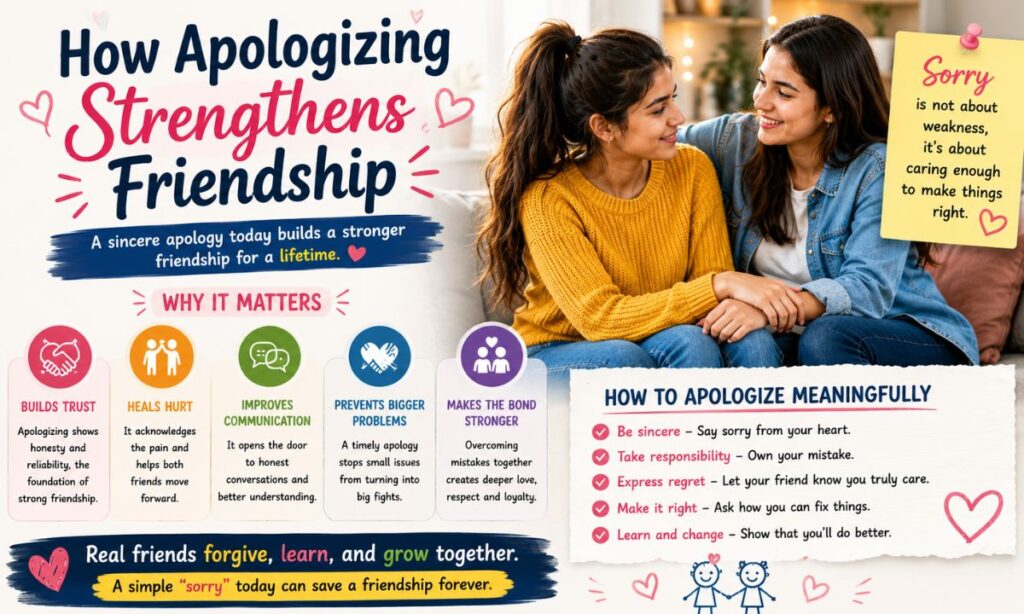
- Apologizing shows a friend that your bond matters more than your ego.
- Every sincere sorry adds another layer of trust to a friendship.
- Saying sorry first often means valuing the friendship over being right.
- Apologies turn friction into deeper understanding between friends.
- A true apology proves you care about your friend’s feelings, not just your comfort.
- Friendships grow stronger through honesty, and honesty starts with a sincere sorry.
- Apologizing shows maturity that strengthens the roots of true friendship.
- A heartfelt sorry can turn a rocky moment into a stronger bond.
- Real friends don’t avoid apologies — they embrace them to grow closer.
- Saying sorry sincerely reminds your friend that they’re worth the effort.
- Apologies rebuild the trust that mistakes sometimes shake.
- A friendship becomes unbreakable when both sides know how to apologize.
- Owning your mistakes shows your friend your loyalty is real.
- Every apology given with love adds strength to a lasting friendship.
- True friends apologize not to win, but to reconnect.
- Saying sorry proves that your friendship means more than your pride.
- A sincere apology can turn silence into laughter again.
- Apologizing shows a friend you’d rather fix things than lose them.
- Strong friendships are built on the courage to admit when you’re wrong.
- A heartfelt sorry can dissolve tension that words alone can’t fix.
- Apologies turn misunderstandings into moments of deeper connection.
- Saying sorry sincerely shows your friend they’re irreplaceable to you.
- True friendship allows space for mistakes and the grace to apologize.
- An honest apology can heal what days of silence cannot.
- Every sincere apology strengthens the foundation of trust between friends.
- Real friends know that sorry isn’t weakness — it’s commitment.
- A friendship deepens when both people learn to say sorry without excuses.
- Apologizing shows a friend that your loyalty outweighs your pride.
- Saying sorry with sincerity can turn conflict into closeness.
- True friends don’t let arguments win — apologies do.
- A heartfelt apology reminds your friend how much they matter to you.
- Owning up to mistakes shows a friend you respect the relationship.
- Every sincere sorry brings friends one step closer to understanding.
- Apologies prove that friendship is stronger than any disagreement.
- Saying sorry sincerely can turn hurt feelings into renewed trust.
- A real friend values reconciliation over being right.
- True apologies show a friend that love outweighs stubbornness.
- Friendships flourish when both sides know the power of a sincere sorry.
- Apologizing keeps friendships alive through life’s inevitable mistakes.
- A heartfelt sorry can turn distance into closeness again.
- Saying sorry proves you value harmony over winning an argument.
- True friends apologize because they can’t imagine losing each other.
- An honest apology strengthens the emotional safety of a friendship.
- Real friendships survive because both people know how to say sorry.
- Apologizing shows a friend that respect outlasts any conflict.
- A sincere sorry can turn a broken moment into a stronger memory.
- True friends apologize quickly because the bond matters more than pride.
- Saying sorry with heart shows a friend they’re always worth the effort.
- Every honest apology adds another thread to a lifelong friendship.
- A heartfelt sorry proves that true friendship is built to last through mistakes
Rebuilding Connection With Your Best Friend
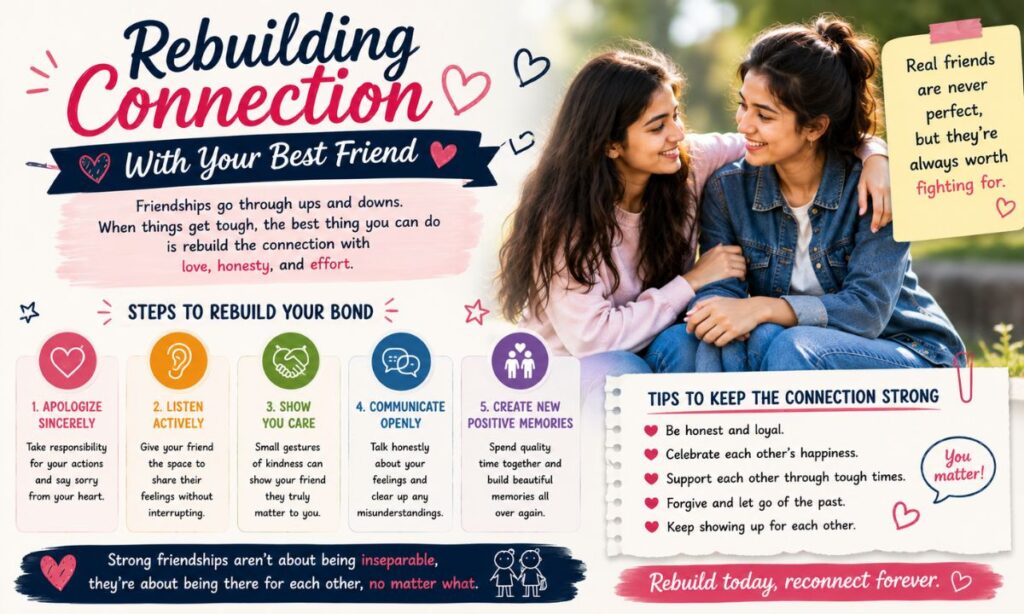
- Rebuilding a friendship starts with the courage to reach out first.
- A broken connection heals faster when both sides choose honesty over pride.
- Rebuilding starts with listening, not just explaining your side.
- True friendships find their way back through patience, not perfection.
- Reconnecting begins the moment you choose the friendship over being right.
- Small gestures of care can rebuild what silence once broke.
- Rebuilding trust takes time, but it starts with one honest conversation.
- A friendship worth saving is worth the effort to repair.
- Reconnecting means showing up, even when it feels uncomfortable.
- Rebuilding a bond starts with acknowledging the hurt, not avoiding it.
- True friends find their way back because the memories are worth it.
- Reconnection begins with vulnerability, not with who apologizes first.
- Rebuilding a friendship means choosing understanding over old arguments.
- A little effort today can rebuild years of shared memories.
- Reconnecting starts with a single message that says, “I miss you.”
- Rebuilding trust means proving with actions, not just words.
- True friendships survive distance when both sides choose to reach back.
- Reconnection grows stronger when both people are willing to forgive.
- Rebuilding starts with letting go of who was “more wrong.”
- A friendship heals faster when both sides stop keeping score.
- Reconnecting means creating new memories to stand beside the old ones.
- Rebuilding a bond takes humility more than it takes perfect words.
- True connection returns when both people choose presence over distance.
- Reconnecting starts with showing up consistently, not just once.
- Rebuilding trust means being patient with the healing process.
- A friendship worth rebuilding is one worth being vulnerable for.
- Reconnection begins the moment pride steps aside for honesty.
- Rebuilding starts small — a text, a call, a simple “I miss us.”
- True friends find their way back because the bond outweighs the break.
- Reconnecting means choosing empathy over defending your side.
- Rebuilding a friendship takes both people willing to meet halfway.
- A little vulnerability can rebuild what silence slowly wore down.
- Reconnection starts with forgiving, even before forgetting.
- Rebuilding trust means consistency, not just one grand gesture.
- True friendships heal when both people choose growth over grudges.
- Reconnecting starts with remembering why the friendship mattered.
- Rebuilding a bond means creating space for honest conversations.
- A friendship worth saving deserves patience through the awkward moments.
- Reconnection grows when both sides show up with open hearts.
- Rebuilding starts with choosing connection over comfort.
- True friends rebuild by focusing on the future, not just the past.
- Reconnecting means letting go of the need to be right.
- Rebuilding trust takes small, consistent proof over time.
- A friendship heals faster when both people choose honesty over ego.
- Reconnection starts the moment you decide the friendship is worth it.
- Rebuilding a bond means being willing to sit in discomfort together.
- True connection returns when both sides choose effort over distance.
- Reconnecting starts with a shared willingness to move forward.
- Rebuilding trust means showing up even when it’s hard.
- A friendship worth rebuilding is one that reminds you why it started.
Why Long Messages Make a Difference
- A long message shows you took the time when a quick text would’ve been easier.
- Long messages prove your feelings couldn’t fit into just a few words.
- Detailed words show a depth of care that short texts often miss.
- A long message says, “You deserve my full attention, not just a reply.”
- Length shows effort, and effort shows how much someone truly matters.
- Long messages leave no room for misunderstanding — every feeling is spelled out.
- A heartfelt paragraph can heal more than a one-word “sorry” ever could.
- Taking the time to write more shows you’re not rushing the relationship.
- Long messages give space for honesty that short replies often hide.
- A detailed message proves you thought it through, not just reacted.
- Longer words often carry the weight that emotions truly deserve.
- A thoughtful paragraph shows patience — the exact opposite of a rushed apology.
- Long messages allow you to explain, reflect, and reconnect all at once.
- Writing more shows you value clarity over convenience.
- A message with depth proves you’re not just saying sorry — you mean it.
- Long texts show you care enough to choose the right words, not just any words.
- Detailed messages leave less room for someone to feel unheard.
- A long message says, “I thought about this more than just a passing moment.”
- Length in a message often reflects the depth of your relationship.
- Long messages give closure that short replies simply can’t offer.
- A thoughtful paragraph shows you respect the other person’s feelings.
- Long-form apologies show accountability instead of just an easy exit.
- Detailed words prove that your care isn’t rushed or half-hearted.
- A long message often says more between the lines than the words themselves.
- Taking time to write shows you’re not afraid of vulnerability.
- Longer messages allow every unsaid feeling to finally find its place.
- A heartfelt paragraph shows patience where a quick text shows haste.
- Long messages prove you’re choosing understanding over shortcuts.
- Detailed apologies show you’ve reflected, not just reacted emotionally.
- A long message can rebuild trust that a short one might not reach.
- Length in words often mirrors the depth of true feelings.
- Long messages give someone the space to feel truly heard.
- A thoughtful paragraph proves the relationship is worth more than a text.
- Writing more shows care that a simple “sorry” can’t always capture.
- Long messages turn simple words into a genuine, heartfelt gesture.
The Emotional Value of Friendship Apologies
- An apology between friends carries the weight of years, not just the moment.
- Sorry, when heartfelt, tells a friend their feelings were never invisible to you.
- The emotional value of an apology lies in what it silently admits — “I was wrong, and you matter.”
- A friend’s apology heals in ways that time alone cannot.
- Saying sorry to a friend proves vulnerability is safe between you two.
- An apology between friends is an act of emotional honesty, not obligation.
- The right apology reminds a friend they were never overreacting.
- Sorry holds emotional weight when it comes from genuine remorse, not guilt alone.
- A friend’s apology can validate feelings that were bottled up in silence.
- Emotional apologies repair not just the moment, but the trust behind it.
- Saying sorry sincerely tells a friend, “Your pain mattered to me too.”
- An apology’s true value lies in the emotional relief it brings both people.
- A heartfelt sorry can release years of unspoken hurt in a single moment.
- Friendship apologies carry more weight because they’re rooted in shared history.
- An emotional apology says, “I see how this affected you, not just what I did.”
- Sorry between friends often means more than sorry between strangers ever could.
- The emotional depth of an apology shows how much the friendship means to you.
- A true apology gives a friend permission to feel, not just to forgive.
- Saying sorry with emotion shows a friend their feelings were never dismissed.
- An apology’s power lies in the vulnerability it takes to say it sincerely.
- Friendship apologies heal because they acknowledge pain, not just the mistake.
- A heartfelt sorry can lift emotional weight a friend has carried alone.
- Emotional honesty in an apology proves the friendship is safe to be real in.
- Saying sorry sincerely tells a friend, “I didn’t take our bond for granted.”
- The emotional core of an apology is empathy, not just admission of fault.
- A true apology between friends says, “Your hurt matters more than my comfort.”
- Emotional apologies restore not just peace, but the feeling of being valued.
- Sorry said with heart can undo emotional distance built by silence.
- Friendship apologies carry the emotional promise of showing up better next time.
- A sincere apology gives a friend space to release what they’ve been holding in.
- The emotional value of sorry lies in the reassurance that they’re still cherished.
- Saying sorry to a friend can heal wounds that logic alone can’t touch.
- An apology rooted in emotion proves the friendship was never just convenience.
- A friend’s apology reminds you both that vulnerability strengthens connection.
- The truest apologies leave a friend feeling understood, not just forgiven.
Conclusion
Friendship is one of life’s greatest gifts, but even the closest bonds go through rough patches. A heartfelt apology can turn things around when words are chosen with honesty and care. It’s not about finding perfect phrases, but about speaking from the heart. The right sorry message can remind your best friend how much they truly mean to you.
Mending a friendship takes courage, patience, and a genuine desire to make things right. These messages are here to help you say what you feel when the right words don’t come easy. Whether it’s a short line or a heartfelt paragraph, sincerity is what matters most. Use these messages as a starting point, and let your true feelings guide the rest.
Frequently Asked Question
What should I say to apologize to my best friend?
Tell them honestly that you’re sorry, acknowledge what you did wrong, and let them know how much their friendship means to you.
How do I write a heartfelt apology message?
Speak from the heart, be specific about your mistake, avoid excuses, and express genuine regret along with a promise to do better.
What is a good sorry message for a best friend?
“I’m sorry for hurting you — our friendship means more to me than being right” is a simple, heartfelt example.
How do you apologize to a friend you hurt deeply?
Acknowledge their pain directly, take full responsibility, and give them space and time to process your apology.
What do you say to fix a broken friendship?
Express genuine remorse, listen to their feelings, and show through actions that you’re committed to rebuilding trust.
How long should an apology message be?
It should be as long as it takes to be sincere — even a few honest sentences can mean more than a lengthy message.
What makes an apology meaningful?
Sincerity, accountability, and empathy make an apology meaningful, not just the words used.
How do I apologize without making excuses?
Simply own your mistake, say sorry directly, and avoid using “but” to justify what happened.
What’s the best way to say sorry to someone you love?
Be honest, vulnerable, and specific about your feelings, showing them their emotions truly matter to you.
Can a long apology message save a friendship?
Yes, a genuine, thoughtful apology can rebuild trust and remind your friend how much they matter to you.
